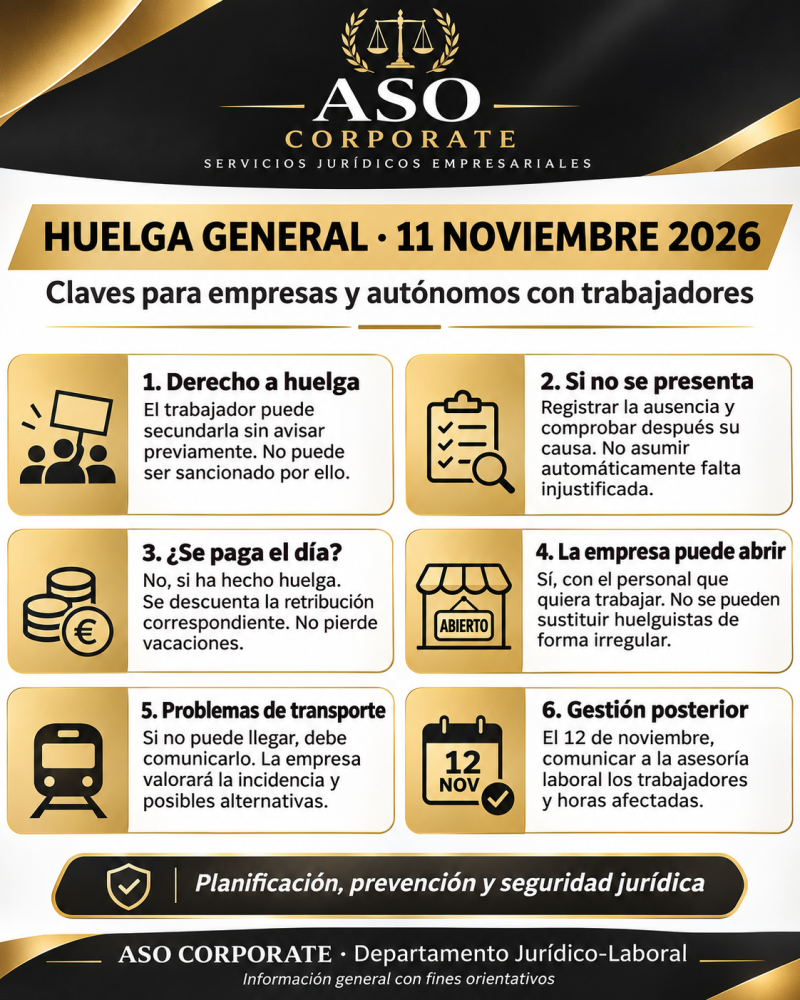
A practical guide to Spanish employment law for business owners, employers, SMEs, industrial companies, logistics businesses and HR departments. Includes a free downloadable workplace strike management checklist.
What should an employer do if employees fail to attend work during a general strike in Spain? Can their wages be deducted? Must employees provide advance notice? Can a factory, warehouse or business continue operating during industrial action?
These are among the most common questions facing company directors, business owners, employers and human resources managers when a general strike is announced.
A 24-hour general strike is scheduled to take place across Spain on Wednesday, 11 November 2026, affecting both the public and private sectors, with specific arrangements applying to certain work shifts.
The strike may also affect businesses operating in Barcelona, Barberà del Vallès, Sabadell, Terrassa, Cerdanyola del Vallès, Ripollet, Rubí, Sant Cugat del Vallès and other industrial and commercial areas throughout Catalonia.
For many companies, particularly those operating in industrial estates, manufacturing facilities, warehouses and logistics centres, a general strike can significantly disrupt production schedules, transport, deliveries and everyday business operations.
At ASO CORPORATE, our Employment Law and Human Resources Department provides legal advice and employment consultancy services to businesses operating in Spain.
In this guide, we explain how employers should prepare for a general strike, manage employee absences, calculate payroll deductions, comply with Spanish Social Security requirements and avoid decisions that could expose their businesses to employment disputes, compensation claims or administrative penalties.
The essential principle is straightforward: employers can organise their business operations, but they must respect employees' fundamental right to strike.
A general strike does not automatically require every company, factory, warehouse, shop or office to close.
Employers may continue operating with legitimately available resources and employees who voluntarily decide not to participate in the strike.
However, companies must respect the legal rights of employees who choose to take industrial action.
The first recommendation is to establish an internal strike management protocol, particularly where the business operates multiple shifts, has production deadlines, uses specialised machinery or depends on transportation and logistics.
An effective protocol should help management:
Organise business operations before the strike.
Identify critical activities and safety requirements.
Record attendance and workplace incidents.
Manage staff absences without infringing employment rights.
Calculate any applicable salary deductions.
Comply with Spanish Social Security reporting requirements.
Maintain appropriate records for subsequent employment or legal reviews.
Proper preparation is particularly important for industrial businesses and SMEs operating in Spain.
This is one of the most frequent concerns raised by employers and HR departments.
Under Spanish employment law, employees may participate in a legally organised strike without providing individual advance notice to their employer.
The right to strike is recognised under Article 28.2 of the Spanish Constitution, while Royal Decree-Law 17/1977 regulates its principal employment-related consequences.
Therefore, if an employee does not attend work on the day of a general strike, the employer should not automatically classify the absence as unauthorised.
We recommend the following procedure:
Check the employee's scheduled working hours and assigned shift.
Review the company's normal working-time and attendance records.
Record the absence or late arrival provisionally.
Document any objective workplace or operational incidents.
Determine whether the absence relates to participation in the strike or another circumstance.
Provide the verified information to the payroll or employment advisory department for the appropriate treatment.
Employers should avoid issuing automatic disciplinary warnings simply because an employee was absent on the day of a general strike.
If the absence is subsequently found to be unrelated to lawful strike participation, the circumstances should be assessed under the Spanish Workers' Statute and the applicable collective bargaining agreement.
No. As a general rule, employees in Spain are not required to notify their employer individually in advance that they intend to participate in a legally organised strike.
Employers should not require staff to complete compulsory declarations confirming whether they intend to strike.
Likewise, employees should not be pressured into providing advance commitments to attend work.
However, employers may issue general communications covering legitimate operational matters, such as:
Workplace access procedures.
Health and safety requirements.
Attendance recording systems.
Emergency contact arrangements.
Procedures for reporting incidents unrelated to strike participation.
The distinction is important.
A company has the right to plan its operations, but it must not interfere with employees' fundamental right to strike.
Yes.
Under Spanish employment law, an employee's employment contract is suspended for the period during which they lawfully exercise their right to strike.
Consequently, the employer is not required to pay the salary corresponding to the period of industrial action.
Depending on the circumstances and applicable legal criteria, deductions may affect:
Ordinary salary corresponding to the strike period.
The legally applicable proportional share of extra salary payments.
Certain salary components and weekly rest remuneration.
However, there are important limitations.
Employers cannot impose additional financial penalties simply because an employee has exercised the right to strike.
Furthermore, participation in a lawful strike must not result in a reduction of the employee's statutory annual holiday entitlement.
Calculating a strike deduction is not always as simple as dividing the monthly salary by 30 days.
The calculation should take into account:
The employee's contractual working hours.
The actual duration of the strike.
The applicable collective bargaining agreement.
The employee's salary structure.
Additional salary payments and relevant allowances.
Any legally applicable effects on weekly rest remuneration.
Incorrect payroll deductions can lead to employment disputes and claims for unpaid wages.
At ASO CORPORATE, we recommend that strike-related salary adjustments be reviewed by an employment and payroll specialist before salaries are finalised.
During a lawful strike, employees remain in a special registered status within the Spanish Social Security system, known as situación de alta especial.
The obligation to contribute to Social Security is suspended for the period of strike participation, subject to the applicable rules.
Employers must correctly report the situation through the procedures established by the Spanish General Treasury of Social Security (Tesorería General de la Seguridad Social – TGSS).
Within the Spanish Sistema RED reporting framework, the following inactivity codes are relevant:
Code 2: Full strike (huelga total).
Code 3: Partial strike (huelga parcial).
The payroll or employment department should verify the relevant dates, hours and applicable contribution treatment.
It is essential to understand that participation in a strike does not terminate the employment relationship or constitute a permanent deregistration from Spanish Social Security.
For international companies operating in Spain, this distinction is particularly important because employment suspension and contract termination are legally different situations.
General strikes can be particularly disruptive for manufacturing, industrial production, logistics, warehousing, transport, distribution and maintenance businesses.
The absence of certain employees may affect production lines, goods deliveries, loading operations, machinery, safety procedures and the continuity of industrial processes.
There may also be transport disruptions, access restrictions or supply chain difficulties, even when some employees are willing to work.
Review shift schedules. Companies operating night shifts, rotating shifts or continuous production systems should check the precise timing of the strike, including any arrangements affecting shifts beginning before or finishing after the official strike date.
Identify critical operations. Determine which processes require specific safety and maintenance measures, while distinguishing these from legally established minimum services.
Review customer and supplier commitments. Assess the possible effects on manufacturing deadlines, distribution, deliveries and raw material supplies.
Prepare for transport disruptions. Consider potential access difficulties affecting industrial estates and logistics facilities.
Document operational incidents. Maintain accurate records of production interruptions, access difficulties, delivery delays and other relevant circumstances.
Avoid unlawful employee replacement. The commercial need to fulfil orders or maintain production does not automatically justify replacing striking employees.
Particular attention should be given to businesses operating continuous production lines, refrigeration facilities, perishable goods storage or potentially hazardous industrial equipment.
In these situations, management decisions should consider both employment law and the company's applicable occupational health and safety obligations.
Every industrial business should assess the specific legal and operational risks associated with its activities before taking extraordinary measures during a strike.
As a general rule, Spanish employment law prohibits employers from hiring external workers specifically to replace employees participating in a lawful strike, subject to the exceptions established by law.
This restriction is set out in Article 6.5 of Royal Decree-Law 17/1977.
Spanish case law also places limits on certain forms of internal employee substitution and outsourcing arrangements designed to undermine the effectiveness of industrial action.
These practices are commonly described in Spanish employment law as:
External strikebreaking (esquirolaje externo): using external personnel to replace striking employees unlawfully.
Internal strikebreaking (esquirolaje interno): using existing employees in circumstances that amount to an unlawful substitution of striking workers.
A company may continue carrying out legitimate business activities with employees who have chosen not to strike, within the applicable legal limits.
However, extraordinary changes to employee duties, transfers from other workplaces or additional outsourcing arrangements require particular care.
The continuation of services normally performed by external contractors must also be assessed according to the existing contractual arrangements and the circumstances.
Before reallocating duties, transferring staff between facilities or engaging additional service providers during a strike, employers should seek specialist advice under Spanish employment law.
Not every absence occurring on the day of a general strike constitutes participation in industrial action.
Some employees may wish to work but experience genuine difficulties reaching their workplace because of transport disruption, road restrictions or access problems.
Employers should distinguish between voluntary strike participation and an inability to attend work for reasons beyond the employee's immediate control.
Employees experiencing such difficulties should normally inform their employer as soon as reasonably possible and provide relevant supporting information where appropriate.
Depending on the circumstances, employers may consider:
Flexible starting times.
Agreed remote working arrangements.
Alternative working schedules.
Other lawful solutions consistent with the applicable collective bargaining agreement.
Transport difficulties do not automatically mean an employee is participating in a strike or that their absence constitutes disciplinary misconduct.
The appropriate salary treatment will depend on the relevant circumstances, applicable legislation and collective agreement.
A general strike does not automatically require businesses to close.
If an employer decides to suspend operations, it is important to distinguish between a genuine inability to continue operating and a formal employer lockout.
Under Spanish law, an employer lockout (cierre patronal) is subject to specific legal requirements.
Article 12 of Royal Decree-Law 17/1977 identifies circumstances in which such a measure may be legally permitted, including certain serious risks to people or property, unlawful occupation of premises, or substantial disruption preventing normal production.
Where a lawful employer lockout is implemented, the relevant notification requirements must also be observed.
Before closing a factory, warehouse, business premises or office because of strike-related circumstances, employers should obtain employment law advice.
This is especially important for companies with complex operations, shift systems or significant health and safety obligations.
The Government of Catalonia (Generalitat de Catalunya) has established minimum service requirements for the general strike scheduled for 11 November 2026 in certain essential sectors.
These include specific activities related to:
Public transport.
Healthcare.
Education.
Social care.
Emergency services.
Essential supplies and other critical services.
Certain essential freight transport operations.
Companies operating in affected sectors should review the specific official resolution applicable to their activities.
It is also important to distinguish between minimum essential services established by the competent public authority and the safety and maintenance activities legally required to protect people, industrial facilities, equipment and materials.
An ordinary industrial company cannot unilaterally impose minimum service obligations merely because it considers its production targets or commercial commitments urgent.
At ASO CORPORATE, we recommend that employers, company directors and HR departments establish a documented procedure for managing industrial action.
Review the strike announcement and its potential effects on working hours, shifts and workplaces.
Assess production schedules, logistics commitments, essential services and customer obligations.
Identify specific health, safety and maintenance requirements.
Inform supervisors and line managers about the legal limits applicable to workplace organisation during a strike.
Maintain the company's normal working-time and attendance recording procedures.
Document absences, late arrivals and relevant workplace incidents objectively.
Respect the rights of employees who decide not to participate in the strike.
Avoid premature disciplinary action and unlawful replacement arrangements.
Keep records of extraordinary circumstances affecting business operations.
Review attendance records and employee absences.
Differentiate between full strike participation, partial participation and other incidents.
Calculate the corresponding salary effects.
Prepare and verify the necessary Spanish Social Security notifications.
Retain relevant documentation in accordance with applicable data protection requirements.
Effective HR management is not simply about identifying who was absent. It requires determining the legal reason for the absence and applying the correct employment, payroll and Social Security treatment.
To help employers manage these situations, ASO CORPORATE has prepared a practical, free downloadable guide for business owners, company directors, employers and human resources managers.
This three-page document is designed to be printed or completed digitally and can be used during general strikes and other lawful industrial action.
Page 1. Before and During the Strike: Employer Checklist
A structured checklist covering shift planning, critical business activities, health and safety, minimum services, attendance records and the initial management of workplace incidents.
Page 2. Individual Employee Incident Record
A reusable form for recording scheduled working hours, absences, full or partial strike participation, transport difficulties and relevant objective circumstances.
Page 3. Post-Strike Payroll and Compliance Checklist
Practical checks covering HR records, salary deductions, Spanish Social Security reporting and documentation to be forwarded to the employment advisory department.
A practical ASO CORPORATE resource to help businesses organise, document and manage workplace incidents during a strike.
The checklist does not replace individual legal advice, but it can help managers identify the main administrative and legal matters requiring attention.
Yes. Under Spanish employment law, employees are not generally required to provide individual advance notice of their participation in a legally organised strike.
Yes. Employers may deduct the legally corresponding remuneration for the period of strike participation, including applicable proportional salary effects.
Not merely for the lawful exercise of the right to strike. Any separate alleged misconduct must be assessed individually.
Yes. Employers must also respect the rights of employees who voluntarily choose to work.
Not to unlawfully replace striking employees. Spanish legislation restricts external replacement, and case law also addresses certain forms of internal substitution.
The employer must assess the operational and safety consequences, but the importance of a particular role does not, by itself, remove the employee's right to strike.
Employers cannot impose this requirement solely as a consequence of the lawful exercise of the right to strike.
The circumstances should be assessed individually. Transport difficulties do not automatically amount to strike participation or disciplinary misconduct.
Employers must correctly report the relevant full or partial strike situations in accordance with TGSS procedures.
Employers should not require compulsory individual advance declarations or interfere with employees' freedom to decide whether to participate.
Companies employing staff under Spanish employment law must comply with the applicable Spanish rules, regardless of where the parent company is incorporated.
Internal corporate HR policies cannot override employees' rights under Spanish law.
Businesses need more than an administrative service that simply processes monthly payroll.
Effective employment management requires an understanding of employers' legal responsibilities, collective bargaining agreements, workplace attendance requirements, staff management procedures and the prevention of employment disputes.
ASO CORPORATE provides employment law advice, payroll administration, Spanish Social Security support and human resources consultancy to companies, SMEs, entrepreneurs and foreign-owned businesses operating in Spain.
Our services support employers in matters including:
Employment contracts and workforce management.
Payroll administration and salary compliance.
Spanish Social Security obligations.
Employee attendance and working-time incidents.
Disciplinary procedures and employment disputes.
Collective bargaining agreement interpretation.
Employment law compliance.
Preventive legal advice for business owners and HR departments.
We provide legal and employment advisory support to industrial, manufacturing, logistics, commercial and service businesses located in Barberà del Vallès, Sabadell, Cerdanyola del Vallès, Ripollet, Santa Perpètua de Mogoda, Sant Cugat del Vallès, Rubí and Terrassa.
These areas include some of Catalonia's significant industrial and business locations, such as:
Barberà del Vallès: Can Salvatella, Santiga and Santa Maria industrial estates.
Sabadell: Can Roqueta industrial estate and surrounding business areas.
Cerdanyola del Vallès: Can Mitjans and Can Fatjó industrial areas.
Rubí: Can Jardí and Cova Solera industrial estates.
We understand the importance of appropriate workforce management, shift planning, employment compliance and business continuity for companies operating in these industrial environments.
We also advise businesses in Vallès Oriental, Granollers, Barcelona and the wider Barcelona metropolitan area, including companies requiring ongoing legal and HR support in English.
For foreign entrepreneurs and international businesses employing staff in Spain, understanding local employment regulations is particularly important.
Spanish employment law may differ significantly from the rules applicable in the United Kingdom, the United States and other jurisdictions.
Employers should ensure that internal HR procedures, payroll systems, attendance policies and employment decisions comply with the applicable Spanish legal framework.
At ASO CORPORATE, we help businesses understand their responsibilities and manage employment matters in Spain with appropriate legal support.
If you are a business owner, company director, managing director, HR manager or employer seeking advice on employee strikes, workplace absences, payroll deductions, Social Security obligations or workforce management, our team can assess your company's situation.
ASO CORPORATE – Employment Lawyers and Business Advisory Services in Spain
Employment Law and Human Resources Department
Barberà del Vallès · Sabadell · Terrassa · Barcelona
Telephone: +34 93 718 50 21
Mobile: +34 622 642 468
Email: hello@asocorporate.com
Website: https://www.asocorporate.com/es
Protect your business with preventive employment law advice, reliable HR management and legally sound workplace procedures.
Official Spanish Gazette – General Strike of 11 November 2026 and Minimum Services.
Government of Catalonia – Minimum Services for the General Strike.
Prepared by: ASO CORPORATE – Employment Law and Human Resources Department.
Published and last updated: 9 November 2026.
This article is provided for general information purposes only and does not constitute individual legal advice. Employment law consequences should always be assessed according to current Spanish legislation, the applicable collective bargaining agreement and the specific circumstances of each business.

Attachment