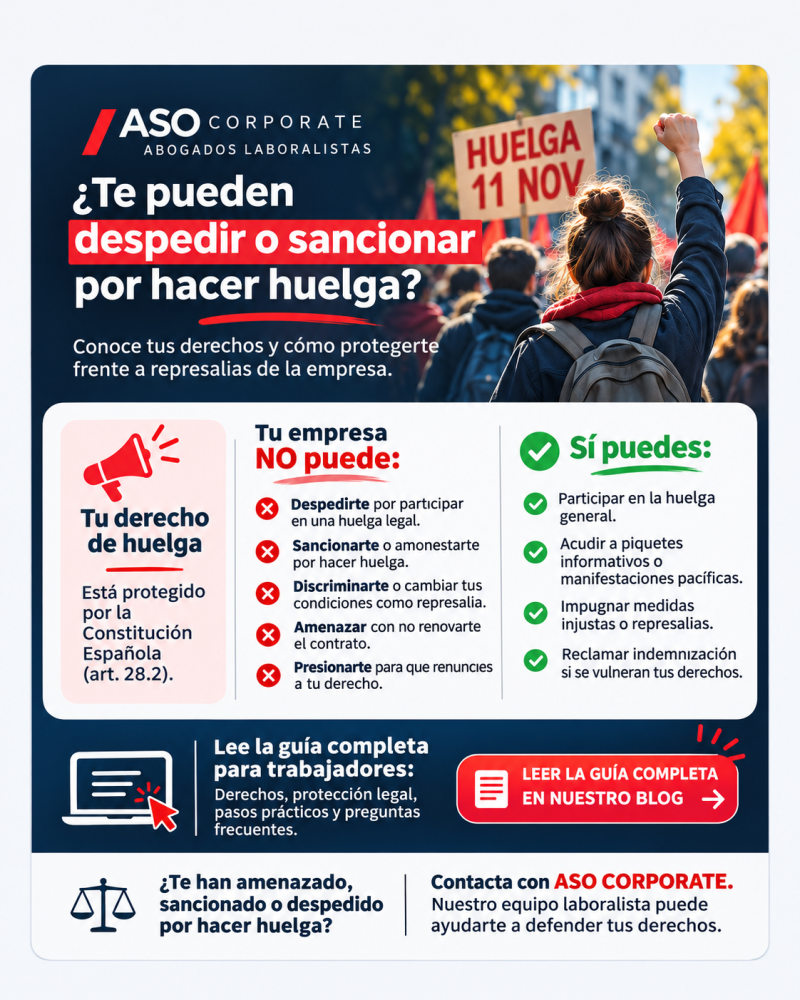
General strike in Spain on 11 November 2026: what to do if your employer threatens, pressures, disciplines, dismisses or discriminates against you for exercising your right to strike. A legal guide for employees working in Spain.
Has your employer warned you that there will be consequences if you go on strike? Have you been threatened with dismissal, loss of bonuses or non-renewal of your employment contract? Has your manager pressured you to confirm that you will not participate in a strike? Have you received a disciplinary warning simply for exercising your employment rights?
If you are experiencing any of these situations, it is important to understand your rights under Spanish employment law and the legal remedies available to protect them.
With the general strike scheduled for Wednesday, 11 November 2026, ASO CORPORATE, an employment law firm serving Barcelona, Sabadell, Barberà del Vallès, Terrassa and the surrounding areas, wants to help employees understand their legal protections against workplace intimidation, discrimination and retaliation.
The right to strike is expressly recognised under Article 28.2 of the Spanish Constitution. It is a fundamental constitutional right, and employees cannot lawfully be punished, dismissed or discriminated against merely for exercising that right through lawful strike action.
Nevertheless, workplace pressure, threats, discrimination and other forms of employer retaliation may occur before, during or after a strike.
If you have experienced any of these situations, you do not have to accept them without seeking legal advice. Spanish law provides mechanisms to challenge unlawful employer conduct, request protection of your fundamental rights and, where appropriate, claim compensation for the harm suffered.
At ASO CORPORATE, our Employment Law Department is available to advise and represent employees who believe their rights have been violated.
Yes. Your right to strike does not depend on your employer's permission.
Article 28.2 of the Spanish Constitution expressly recognises employees' right to strike in defence of their interests.
Article 6 of Royal Decree-Law 17/1977 also establishes that lawful strike participation does not terminate the employment relationship and cannot, in itself, justify disciplinary action.
Therefore, if a lawful strike has been called and you are entitled to participate, you may exercise this right even if your employer objects.
A company cannot unilaterally prohibit its employees from participating in a lawful strike simply because it has production targets, commercial commitments, staffing shortages or important customer orders.
A company's operational needs do not override employees' fundamental right to strike.
However, strike action must remain within the applicable legal limits, including those relating to essential services, workplace safety and the rights of other employees.
No. As a general rule, employees in Spain are not required to provide individual advance notice of their intention to participate in a legally organised strike.
You do not need your employer's authorisation, nor are you generally required to explain your personal reasons for joining the strike.
Employers may issue legitimate workplace communications concerning safety, access procedures and business organisation, but they cannot use those communications to pressure employees into giving up their right to strike.
The mere act of asking a question does not automatically constitute a breach of fundamental rights. The context, purpose and potential consequences must be considered.
However, it may be legally questionable for an employer to require employees to sign compulsory declarations renouncing their right to strike or to threaten those who refuse.
Employees must not be forced to make advance commitments waiving their fundamental right to strike.
If you believe your employer is applying pressure, keep copies of relevant emails, messages and other communications that may help establish what happened.
No. A dismissal motivated by the lawful exercise of the right to strike violates a fundamental right and may be declared null and void under Spanish employment law.
Article 55.5 of the Spanish Workers' Statute provides that a dismissal is null when it violates an employee's fundamental rights or public freedoms.
If a company dismisses an employee in retaliation for lawful strike participation, and that violation is established in court, the legal consequences are different from those of a dismissal classified as merely unfair.
As a general rule, a declaration of nullity entails:
Reinstatement to your position.
Payment of back wages in accordance with the applicable legal rules.
Restoration of the rights that were violated.
The possibility of additional compensation for emotional distress or other damage, where legally justified.
It is important to understand that not every dismissal occurring after a strike is automatically null and void.
The circumstances must be assessed to determine whether the employer's decision was genuinely connected to the exercise of the right to strike.
You also have the right to participate in a lawful strike.
Having a temporary contract, limited seniority or being within a probationary period does not allow an employer to terminate your employment in retaliation for exercising a fundamental right.
If the real reason for the termination is strike participation, the decision may be challenged as a violation of fundamental rights.
An employer cannot lawfully impose a disciplinary sanction or formal warning merely because you have participated in a lawful strike.
Situations that may require legal review include:
Receiving a written warning because you did not attend work during the strike.
Being disciplined for refusing to withdraw from the strike.
Being suspended from work without pay as punishment for participating.
Being told that your participation will affect future promotions.
Receiving threats of dismissal for exercising your right to strike.
Being subjected to apparently routine disciplinary measures that may conceal retaliation.
These situations must be distinguished from any separate workplace misconduct that may occur during a strike, since the right to strike does not protect every possible action.
Keep a complete copy of the letter and seek advice from an employment lawyer as soon as possible.
If you are asked to sign solely to acknowledge receipt, you may indicate "Received, not agreed" (recibido, no conforme), together with the actual date of receipt.
However, this statement does not replace a formal legal challenge.
Do not ignore a disciplinary sanction simply because you believe it is unfair. Spanish employment law establishes deadlines for challenging disciplinary decisions.
Employer retaliation does not always take the form of dismissal or a formal disciplinary sanction.
Sometimes it appears through changes to working conditions, apparently routine management decisions or unfavourable treatment after an employee has participated in industrial action.
Changes to working hours or shifts. When used to punish an employee for participating in a strike rather than for legitimate organisational reasons.
Transfers or changes in duties. When the real objective is to disadvantage an employee for exercising their rights.
Exclusion from promotions or training. If professional opportunities are denied because of strike participation.
Withdrawal of bonuses or allowances. Where the measure is discriminatory rather than a lawful consequence of time not worked.
Threats not to renew a contract. When non-renewal is used as retaliation for participation in a strike.
Hostile or intimidating treatment. Where conduct is intended to punish, isolate or disadvantage an employee for exercising employment rights.
Assignment of disadvantageous duties. When changes to normal responsibilities are imposed as punishment for participation in industrial action.
Not every change in employment conditions following a strike automatically amounts to discrimination.
The central legal question is whether the employer's decision is connected to the employee's exercise of their right to strike.
At ASO CORPORATE, we assess these circumstances to determine whether there is evidence of unlawful retaliation and which legal remedies may be available.
An employer cannot lawfully use your participation in a strike as a reason to retaliate against you.
This issue may be particularly concerning for employees working under fixed-term contracts, short-term employment arrangements or probationary periods.
For example, if a manager expressly states that employees who participate in the strike will not have their contracts renewed, that statement may constitute relevant evidence of a potential violation of fundamental rights.
Messages, witness statements or changes in the employer's normal decision-making criteria may also be relevant when assessing whether a disadvantageous decision is connected to strike participation.
Your fundamental right to strike does not disappear simply because you have a temporary contract or have recently joined the company.
Yes, but only within the limits established by Spanish employment law.
During lawful strike participation, the employment contract is suspended and the employer is not required to pay the salary corresponding to the period of strike action.
Depending on the applicable legal criteria, deductions may also affect certain proportional salary components, including extra salary payments and weekly rest remuneration.
However, an employer cannot use payroll deductions to impose additional punishment.
An employer cannot reduce your statutory annual holiday entitlement merely because you have participated in a lawful strike.
Likewise, additional financial penalties cannot be disguised as ordinary payroll adjustments when their real purpose is to punish strike participation.
If you participated in a partial strike, the calculation must reflect the relevant hours and applicable salary components.
If you notice an excessive or incorrect salary deduction, you may request a review and, where appropriate, claim the outstanding wages.
As a general rule, an employer cannot force you to abandon a lawful strike.
However, certain situations involving essential services or activities required to protect people, property and workplace safety may be subject to specific legal obligations.
For essential public services, minimum service requirements must be supported by the relevant legally authorised measures.
A private company cannot simply declare that all employees are required to work because it has urgent orders, a large workload or insufficient staffing.
The fact that your work is important to production or business operations does not automatically remove your right to strike.
It is necessary to determine whether a specific legal obligation applies to the services or safety activities concerned.
If your employer claims that you must work because of minimum service requirements, you should seek information about the legal decision or provision supporting that obligation.
Article 6.6 of Royal Decree-Law 17/1977 recognises the right to publicise a strike peacefully.
This allows employees and strike participants to engage in lawful informational activities associated with industrial action.
However, the exercise of the right to strike must also respect the freedom of employees who choose not to participate.
Threats, violence and unlawful coercion are not protected by the right to strike.
The relevant safety rules and legal requirements for demonstrations and public gatherings must also be respected.
If you have experienced threats, disciplinary action, pressure, discrimination or other unfavourable treatment connected to strike participation, several legal avenues may be available.
An employment lawyer can assess the facts, review relevant communications, identify the rights potentially affected and determine the appropriate legal response.
Not every employment dispute requires the same procedure.
In some cases, an urgent challenge to a dismissal or disciplinary sanction will be necessary. In others, a claim for the protection of fundamental rights or another employment law action may be appropriate.
If there is evidence of possible breaches of employment law, a formal complaint may be submitted to the Spanish Labour and Social Security Inspectorate (Inspección de Trabajo y Seguridad Social – ITSS).
The Labour Inspectorate has powers to investigate potential infringements and take appropriate action within its statutory responsibilities.
A formal complaint should be distinguished from an informal report submitted through an online irregularities reporting channel, as the procedures and consequences are different.
Filing a complaint with the Labour Inspectorate does not necessarily replace court proceedings or automatically suspend the deadlines for challenging a dismissal or disciplinary sanction.
Spanish Law 36/2011, regulating the social jurisdiction, provides procedures for the protection of fundamental rights, including the right to strike.
Depending on the circumstances, an employee may seek:
A judicial declaration that a fundamental right has been violated.
Nullification of the unlawful employer decision.
An order requiring the employer to stop the unlawful conduct.
Restoration of the situation existing before the violation.
Compensation for proven damage, including non-material harm where appropriate.
Where the alleged violation arises through a dismissal or disciplinary sanction, the applicable procedural route must be followed while incorporating the corresponding fundamental rights claims.
Yes. Where a violation of fundamental rights is established, an employee may be entitled to compensation for emotional distress and other damage.
Article 183 of the Spanish Law Regulating the Social Jurisdiction requires the court to address the compensation that may be appropriate for a violation of fundamental rights.
The purpose of compensation is to repair the harm caused and help prevent further unlawful conduct.
There is no single amount applicable to every case.
The amount will depend on the specific circumstances, the nature and seriousness of the infringement, its duration, the harm suffered and the applicable legal criteria.
In certain circumstances, compensation for violation of fundamental rights may be compatible with other financial consequences arising from the employment proceedings.
Before accepting disciplinary action or discriminatory treatment, it is advisable to obtain legal advice about the possibility of challenging the employer's decision and claiming compensation.
This is an especially important aspect of employment litigation involving fundamental rights.
Spanish procedural law establishes specific rules regarding the burden of proof in these cases.
Under Articles 96.1 and 181.2 of Law 36/2011, where an employee presents sufficiently grounded indications of a violation of fundamental rights, the employer must provide an objective and adequately supported justification for the measures taken and demonstrate their proportionality.
This does not mean that every claim will automatically succeed or that an employee is exempt from presenting evidence.
Rather, Spanish law provides specific procedural protection against employer decisions that may conceal retaliation.
Preserving evidence from the beginning can therefore be essential to protecting your rights.
If you believe your employer is violating your rights, it is advisable to document the situation as soon as possible.
WhatsApp messages, emails or employer communications related to the strike.
Written warnings, disciplinary letters or dismissal notices.
Communications concerning changes to shifts, duties, working hours or employment conditions.
Payslips issued before and after the strike.
Details of potential witnesses to threats or pressure.
Dates and descriptions of relevant conversations or incidents.
Any other lawfully obtained evidence connecting the employer's decision to your exercise of the right to strike.
If you receive an important verbal communication, it may be useful to record the date, location, people present and substance of what was said.
Avoid obtaining evidence through unauthorised access to company information or by unlawfully infringing the rights of third parties.
The difference between suspecting workplace retaliation and being able to establish it legally may depend on the evidence you preserve.
Acting quickly is essential.
As a general rule, the deadline for challenging a dismissal in Spain is 20 working days, in accordance with Article 103 of the Spanish Law Regulating the Social Jurisdiction.
The same general time limit applies to challenges against disciplinary sanctions under Article 114 of that law.
Saturdays, Sundays and the legally applicable public holidays are excluded from the calculation.
Submitting a formal conciliation request may affect the running of the deadline where legally applicable, but the specific procedural requirements must be assessed.
Do not wait for your employer or the Labour Inspectorate to respond before consulting an employment lawyer if you have been dismissed or disciplined.
Claims for protection of fundamental rights are subject to the rules and deadlines applicable to the specific legal action being brought.
Yes. Trade union membership is not a requirement for participating in a lawful strike that applies to you.
Yes. Having a temporary contract does not, by itself, exclude the right to strike.
Yes. An employer cannot lawfully retaliate against an employee for exercising a fundamental right simply because they are on probation.
An employer cannot lawfully impose a compulsory advance waiver of your fundamental right to strike.
No. Lawful strike participation cannot be used to reduce your annual holiday entitlement.
Not as retaliation. Changes to working arrangements must have legitimate grounds and comply with applicable law.
As a general rule, individual advance notice of lawful strike participation is not required. Failure to give such notice does not, by itself, justify disciplinary action.
A dismissal following a strike is not automatically unlawful. However, it may be declared null and void if it is genuinely motivated by retaliation for lawful strike participation.
The absence of a written threat does not necessarily prevent legal action. Witness testimony and other supporting evidence may be relevant.
In certain circumstances, yes. Threats, coercion and other acts infringing employment rights may justify legal or administrative action, depending on their nature and seriousness.
Yes, where the legal requirements are met and a compensable violation is established.
Employees working under Spanish employment law are generally protected by the constitutional right to strike, regardless of their nationality.
The specific application of employment rights depends on the relevant legal and contractual circumstances.
A foreign-owned company employing staff in Spain must comply with the Spanish employment rules applicable to those employees.
Internal corporate policies cannot override fundamental employment rights protected by Spanish law.
At ASO CORPORATE, we provide legal advice and representation to employees facing workplace decisions that may violate Spanish employment legislation or fundamental rights.
Our Employment Law Department advises clients on unfair and null dismissals, disciplinary sanctions, workplace discrimination, employer retaliation, unpaid wages and other employment disputes.
If you have exercised your right to strike and subsequently received a disciplinary warning, threats, disadvantageous changes to your working conditions or a dismissal, we can review your circumstances and assess which legal actions may be available.
We provide employment law advice to employees working in:
Sabadell, Barberà del Vallès, Cerdanyola del Vallès, Ripollet, Santa Perpètua de Mogoda, Polinyà, Sant Quirze del Vallès, Terrassa, Rubí, Sant Cugat del Vallès, Badia del Vallès, Granollers and Barcelona.
We assist employees across a range of sectors, including manufacturing, industrial production, logistics, retail, hospitality, offices and professional services.
Our objective is to help employees understand their legal position and obtain appropriate representation when they believe their employment rights have been violated.
You do not have to accept workplace retaliation without understanding your legal rights and the remedies available to you.
At ASO CORPORATE, we can help you:
Review a disciplinary warning or dismissal letter.
Assess workplace threats and potential employer retaliation.
Check potentially unlawful salary deductions.
Prepare a complaint to the Spanish Labour Inspectorate where appropriate.
Challenge disciplinary sanctions and dismissals.
Seek judicial protection of fundamental rights.
Claim compensation where legally justified.
Contact our employment lawyers to discuss your situation and understand your options under Spanish law.
ASO CORPORATE – Employment Lawyers and Workers' Rights Legal Representation
Employment Law Department
Barberà del Vallès · Sabadell · Terrassa · Barcelona
Telephone: +34 93 718 50 21
Mobile: +34 622 642 468
Email: hello@asocorporate.com
Website: https://www.asocorporate.com/es
Your right to strike is protected by the Spanish Constitution. If you believe your employer has violated that right, we can help you seek appropriate legal protection.
General Strike in Spain: A Practical Guide for Employers and HR Managers – ASO CORPORATE
Spanish Constitution, Article 28.2 – Fundamental Right to Strike.
Royal Decree-Law 17/1977 – Regulation of the Right to Strike.
Spanish Workers' Statute – Employee Rights and Null Dismissal.
Law 36/2011 Regulating the Social Jurisdiction – Articles 96, 103, 114 and 177–184.
Government of Catalonia – Minimum Services During the General Strike.
Prepared by: ASO CORPORATE – Employment Law Department.
Published and last updated: 9 November 2026.
This article is provided for general information purposes and does not constitute individual legal advice. Whether an employer has violated fundamental rights, whether a dismissal or sanction is null and void, and whether compensation is payable depend on the specific circumstances, available evidence and the competent court's decision. Employment claims may be subject to short statutory deadlines and should be assessed individually.

Attachment